Compare thermoforming and injection molding by part size, tooling, volume, materials, detail, tolerances, lead time, total costs, and production risk.
How the two processes work
In thermoforming, a flat sheet is clamped and heated until it becomes flexible. Vacuum, pressure, mechanical assistance, or a combination of these forces draws the sheet against a tool. After cooling, the part is released and trimmed. Readers who need a fuller process overview can review What Is Thermoforming? Process, Types and Applications.
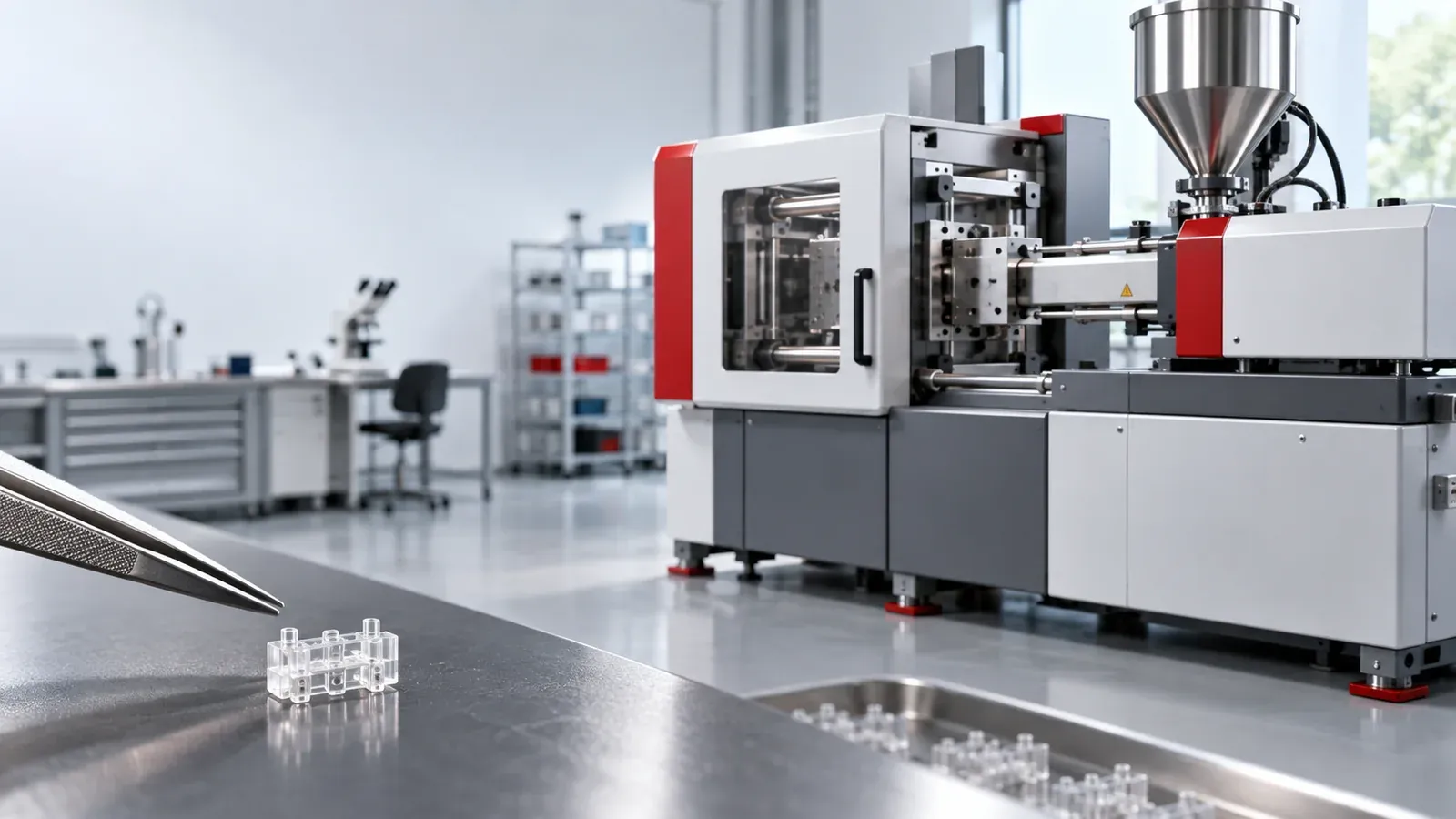
Injection molding begins with pellets or granules. The material is melted in a heated barrel, moved forward by a screw, and injected into a closed metal mould. The plastic fills the cavity, cools, and is ejected as a near-net-shape part.
Join PlasticParts Hub
Create an account to connect with companies and send RFQs.
Thermoforming shapes an existing sheet. Injection molding creates the part by filling a cavity with molten material. Neither principle is inherently better; each creates a different set of advantages and constraints.
Tooling cost and development time
Thermoforming tools are commonly single-sided and may be made from aluminium, composites, or other tooling materials selected for the expected volume and finish. This can make prototype and production tooling comparatively straightforward, especially for large parts with accessible geometry.
Injection moulds are usually more complex because they include two matched halves, cooling channels, ejection systems, gates, vents, and sometimes slides or lifters. The additional engineering and machining can increase initial cost and development time.
That does not mean thermoforming always has inexpensive tooling or injection molding always has expensive tooling. A large pressure-forming tool with demanding cosmetic requirements can be a substantial investment, while a simple injection mould for a small component may be commercially reasonable. The useful comparison is the complete validated tooling package for the actual part.
Production volume and unit economics
Injection molding is often strong at high production volumes. Once a stable mould and automated cycle are in place, short cycle times, repeatability, and limited secondary trimming can reduce unit cost.
Thermoforming can be attractive for prototypes, bridge production, low and medium volumes, large components, and products where tooling cost must remain proportionate to demand. Roll-fed thin-gauge thermoforming can also run at very high volumes for packaging, so it should not be classified only as a low-volume process.
The break-even point is not fixed. Part weight, cycle time, cavities, sheet utilisation, trim scrap, labour, automation, material price, maintenance, and forecast stability all affect the result. A lifecycle cost model is more useful than a rule based only on annual quantity.
Part size and geometry
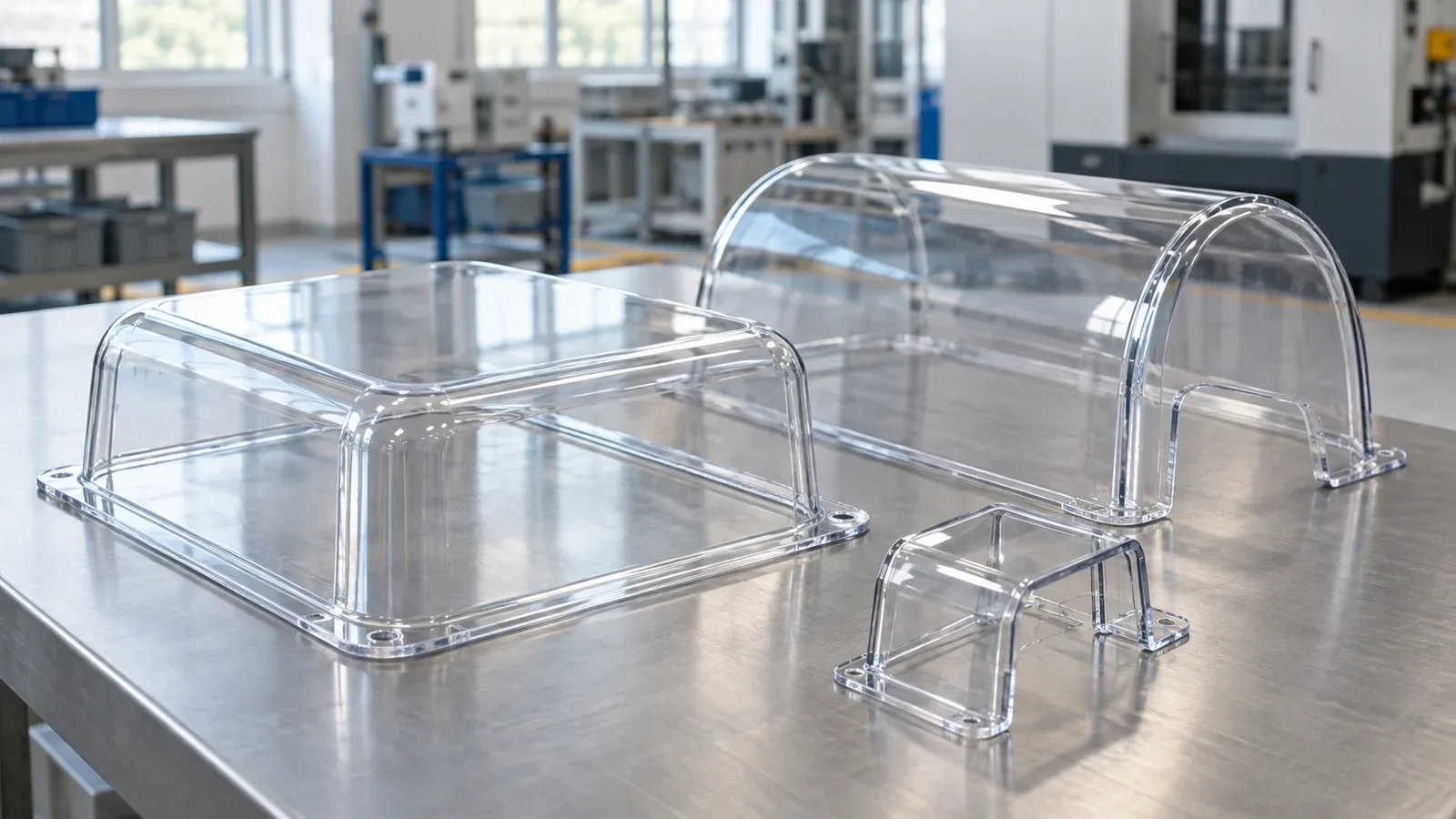
Thermoforming is particularly well suited to large, relatively thin-walled shapes such as equipment housings, vehicle panels, refrigerator liners, trays, machine guards, and interior components. Producing comparable surface area by injection molding may require a very large mould and machine.
Injection molding is better suited to many compact, highly detailed three-dimensional parts. It can form ribs, bosses, clips, threads, snap fits, internal details, and features on both sides of a component in one cycle.
Conventional thermoforming mainly controls detail on the side of the sheet that contacts the tool. Features on the opposite side are more limited, although pressure forming, twin-sheet forming, inserts, assembly, and secondary machining can extend the design range.
Deep draws and sharp transitions can thin a thermoformed sheet because the original material must stretch across the tool. Injection-moulded parts face different risks, including sink, warpage, cooling variation, and internal stress. Both processes benefit from early design-for-manufacture review.
Surface quality and appearance
Both technologies can produce high-quality visible parts.
Thermoforming can preserve an extruded sheet surface with colour, gloss, texture, protective film, decorative cap layers, or multilayer construction already built into the material. Pressure forming can reproduce sharper detail.
Injection molding can produce fine mould texture, accurate logos, crisp edges, and complex surface transitions. Colour and additives are introduced through the resin, and in-mould decoration or specialist finishing may be available.
The best option depends on which side is visible, required texture, allowable witness marks, colour control, and whether post-processing is acceptable.
Material choice
Both processes use thermoplastics, but in different forms. Thermoforming relies on extruded sheet, while injection molding normally uses pellets.
Sheet availability can influence a thermoforming project. The required polymer, grade, colour, texture, thickness, cap layer, minimum order quantity, and recycled content must be commercially available or custom extruded. Thermoforming Materials: How to Choose the Right Plastic explains these considerations in more detail.
Injection molding offers a broad range of pelletised resins, reinforced compounds, engineering plastics, elastomers, and additive packages. However, not every resin is suitable for every geometry, mould, finish, or regulatory requirement.
Material selection should follow performance needs rather than process preference. Temperature, impact, chemicals, UV exposure, flame behaviour, compliance, appearance, and recycling goals all matter.
Tolerances, repeatability, and secondary operations
Injection molding can provide strong dimensional repeatability for suitable designs and controlled production systems. It is often selected for mating components, precise features, integrated fasteners, and parts that should leave the mould with minimal additional work.
Thermoformed parts usually require trimming, and many heavy-gauge components also need drilling, routing, bonding, inserts, painting, or assembly. Five-axis CNC trimming can be accurate and flexible, but it adds another process step.
This does not automatically make thermoforming less suitable for engineered products. The question is whether dimensions, trim references, assembly interfaces, and inspection can be controlled economically. Large injection-moulded parts can also warp, shrink, or require post-mould operations.
Design changes and product risk
Thermoforming can offer flexibility when a design is still evolving. Tool modifications or replacement tools may be quicker and less disruptive, depending on construction.
Injection mould changes can be straightforward when they involve removable inserts or local adjustments, but major geometry changes may be expensive. The higher tooling commitment makes design maturity and demand certainty especially important.
For a new product, thermoforming may suit prototypes or early production before a later move to injection molding. In other cases, the part should be designed for injection molding from the beginning because integrated features are central to the product.
Questions to answer before choosing
What are the overall dimensions and target wall thickness?
Which features must be formed or moulded into the part?
Which surfaces are visible?
What annual volume and product life are realistic?
How stable is the design?
Which material properties and certifications are mandatory?
What tolerances and assembly interfaces matter?
Which secondary operations are acceptable?
What tooling budget and launch date are available?
How will freight, maintenance, and design changes affect total cost?
The final choice should come from part data and supplier feedback, not from loyalty to one technology. For important projects, compare both routes with companies that can explain assumptions, tooling scope, and lifecycle cost.
Choose the process that fits the product
Thermoforming and injection molding are complementary technologies. Thermoforming is often effective for large shells, sheet-based products, flexible tooling strategies, packaging, and projects where surface area or development speed matters. Injection molding is often effective for integrated geometry, repeatable small and medium parts, complex features, and stable high-volume production.
The better process is the one that meets the product’s requirements at an acceptable total cost and risk. After defining the likely route, use How to Find the Right Thermoforming Companies and Suppliers to structure a supplier shortlist and compare capabilities on a like-for-like basis.
Tools Factory’s ENERGYLINE vacuum thermoforming series has been nominated for Poland’s “Teraz Polska” promotional emblem, highlighting its energy-saving dynamic heating system.