
Part weight can guide automatic process correction. Learn how to define the measurement, validate control limits and retain the checks needed for critical part features.
Injection molding part weight control can reveal process drift before a production team receives a dimensional inspection report. Connecting that measurement to the machine controller adds another capability: correcting subsequent cycles. The useful question is which defects the weight signal can detect, and which still need their own checks.
AQCplus brings the scale into the control loop
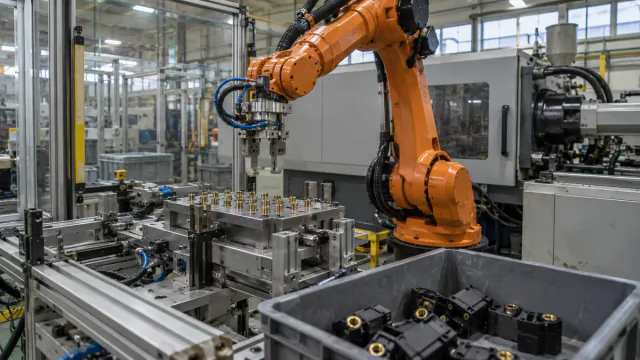
In its September 2, 2026 announcement, KraussMaffei describes AQCplus as a system that measures part weight after every cycle and returns the result to the machine controller. The controller adjusts the hold-pressure profile in response to deviations. It complements APCplus, which uses a viscosity index. KraussMaffei plans to demonstrate the arrangement on a PX 80 cell at Fakuma 2026, with a robot removing and weighing polyamide electrical components. As of October 1, that demonstration is still upcoming.
The measured part has already been molded. Its weight can inform the next correction and its acceptance decision; a control adjustment cannot repair it retrospectively. Buyers should ask how the cell separates a rejected part while the process returns to its approved range.
Weight is useful only when the measurement is defined
Start by specifying what goes on the scale. One finished part, a complete shot with its runner, and a group of parts from several cavities are different measurements. A controller needs a consistent definition, not simply a target number.
For a multi-cavity mold, a stable combined weight can hide imbalance. One cavity may gain material while another loses it. If the specification applies to each part, establish how individual cavities will be checked and how their identity will survive removal, weighing and rejection.
The weighing method also belongs in the process specification. Check the scale's usable resolution against the permitted weight variation, then assess repeatability under production conditions. Robot placement, settling time, vibration and debris on the weighing surface can affect the result. An instrument that performs well on a quiet bench must still produce a trustworthy signal inside the cell.