A practical PPWR checklist for buyers of PET and PP trays: phased dates, complete-pack specifications, food-contact evidence and recycled-content records.
The EU Packaging and Packaging Waste Regulation, usually shortened to PPWR, began applying on 12 August 2026. For buyers of thermoformed trays, the immediate task is to review the pack specification and its supporting evidence. The regulation has a phased timetable; its start date does not bring every future obligation into effect. The European Commission’s application announcement sets out that distinction.
A purchase order that describes only “recyclable PET tray” leaves important questions unanswered. Which lid, coating, label and adhesive are included? What food will the pack contain? Which recycling stream is the supplier assessing? Those details should be settled before a new sheet formulation or tool is approved.
The dates belong in the compliance plan
For the main requirements discussed here, Regulation (EU) 2025/40 sets these dates, with applicable exceptions:
Design-for-recycling requirements: 1 January 2030 or 24 months after the relevant delegated acts enter into force, whichever is later.
Minimum recycled content: 1 January 2030 or three years after the relevant implementing act enters into force, whichever is later.
Recycling at scale: 1 January 2035 or five years after the relevant implementing acts enter into force, whichever is later.
Harmonised material-composition labels: 12 August 2028 or 24 months after the relevant implementing acts enter into force, whichever is later.
The relevant provisions are in Articles 6, 7 and 12. Treat these as planning milestones and check the applicable secondary legislation before fixing a launch deadline.
Join PlasticParts Hub
Create an account to connect with companies and send RFQs.
One requirement already applies: food-contact packaging must meet the PPWR’s PFAS limits. The Commission announcement identifies this as a measure starting in August 2026. Ask the supplier how it demonstrates compliance for the supplied pack, including coatings and other components.
Compare complete PET and PP packs
Start with the product and filling process. Record the food type, filling temperature, storage conditions, shelf-life requirement and any heating in the container. Then compare candidate structures against that same brief. A resin substitution is useful only if the resulting pack still performs its job.
For a PET tray, list the sheet layers, any barrier or surface treatment, the lidding film, sealant, label, ink and adhesive. For a PP tray, build the same component list. Specify the mass of each component and identify which ones remain attached after opening.
This prevents a common procurement mismatch: the converter assesses an undecorated tray, while the customer sells it with a different lid and a large label. Ask for a review of the version consumers will discard. If the artwork or closure changes, send the revised pack back through that review.
RecyClass packaging guidelines evaluate compatibility with particular recycling streams and provide separate guidance for PET thermoforms and PP containers. They are a useful technical reference for discussing labels, adhesives and closures. A voluntary assessment needs to be identified by its method, version and scope; avoid presenting it as a final PPWR compliance determination.
For the earlier material choice, our guide to selecting thermoforming plastics provides context for comparing candidate polymers. Keep the pack’s intended use alongside that comparison.
Give barrier and decoration choices an owner
Barrier layers, anti-fog treatments and seal systems should have a documented purpose. Ask the packaging team to state what each feature achieves and how that performance was measured. For example, a barrier specification should be tied to a shelf-life requirement and test conditions, rather than copied from an older pack.
Make the supplier responsible for identifying the assessed structure. Make the customer responsible for disclosing the final decoration and use conditions. Agree who approves a change to the label stock, adhesive, pigment, sheet supplier or lid. Otherwise, a small purchasing substitution can leave the compliance file describing a pack that is no longer made.
Keep food-contact evidence in the same project file. The European Commission’s food-contact rules cover safety obligations separate from packaging recyclability. Evidence for one question does not answer the other.
Separate recycled content from production scrap
Ask the supplier to identify the origin and accounting basis of any recycled-content claim. Article 7 concerns material recovered from post-consumer plastic waste, with calculations organized by packaging type and format as an annual manufacturing-plant average. The regulation also contains exclusions and derogations.
In the purchasing specification, distinguish post-consumer material from production trim and other factory scrap. Record the intended content, the evidence supplied with deliveries and the procedure for a shortage or formulation change. Do not let a generic “recycled” field conceal which material the quotation actually includes.
Before signing off a new tray, request one controlled file containing the complete component specification, drawings, use conditions, food-contact evidence, substance-compliance evidence, recycling assessment and recycled-content documentation. Tie each item to a revision number and supplier site.
Approve production samples against that revision. Include seal integrity, denesting, stacking and transport checks appropriate to the application. Keep the acceptance criteria explicit so a lighter or differently formulated tray can be compared with the current pack.
When approaching thermoforming suppliers, send this brief with the inquiry. It gives suppliers a defined pack to quote and makes gaps in evidence visible before tooling and launch commitments.
Thermoforming
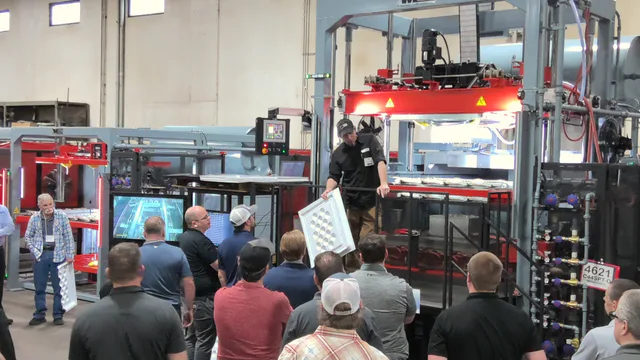
Heavy Gauge Thermoforming: MAAC Demonstrates Forming and Twin-Sheet Processes
MAAC's April SPE workshop demonstrated part forming and single-oven twin-sheet processing. What buyers should document when planning their own equipment trial.